
Hatch’s Jonathan Cournoyer on Keeping the LEP Relevant
By Jonathan Cournoyer
From Issue 3, 2026 of Breakbulk Magazine
 In our industry, a logistics execution plan (LEP) is often developed during the early stages of a project, approved as the study-phase basis, but not always revalidated before execution begins.
That approach may have been tolerable when assumptions remained stable for longer periods.
Today, it is a significant risk.
At Hatch, we have observed that one of the most common gaps between study and execution is not the quality of the original logistics planning. Rather, it is the assumption that the original plan remains valid years later. The conditions that shaped the study-phase LEP may have changed completely by the time procurement is underway and construction is preparing to mobilize.
Projects are no longer being executed in a stable environment. Supply chains are being influenced by shifting trade policies, geopolitical tensions, changing carrier networks, security concerns and evolving regulatory requirements. What was considered the optimal logistics strategy during feasibility may no longer be feasible when execution begins. In recent years, trade flows, transportation costs and routing options have changed rapidly in response to global events.
For this reason, we believe every major project should treat the transition from study to execution as a formal decision point to reassess and refresh the LEP.
This reassessment should be a structured LEP revalidation involving logistics, procurement, engineering, construction, project controls, health and safety, the environment, site materials management, and, where appropriate, key logistics service providers. The review should confirm the current transportable envelope, updated equipment weights and dimensions, final sourcing origins, Incoterms strategy, customs and tariff assumptions and route survey validity.
It should also verify seasonal restrictions, site receiving constraints, packaging and preservation requirements, marine and transport insurance conditions, logistics budgets and schedule alignment with required-on-site and construction work package dates.
Any variance from the study-phase basis should be captured, risk-ranked, costed and either accepted, mitigated or escalated through project change control.
One of the first areas we revisit is equipment data. It is not uncommon for equipment dimensions and weights to evolve as engineering progresses. A module that was initially assumed to weigh 250 tons may ultimately be specified at 300 tons. A crusher, transformer, or processing vessel may increase in size as detailed design advances and vendors are selected.
These changes can dramatically affect transportation methods, route selection, permitting requirements, bridge analyses, crane availability and site handling strategies. A logistics route that worked perfectly during feasibility may suddenly become constrained by a bridge crossing, turning radius or seasonal road limitation.
We also frequently see sourcing strategies evolve. During a study, equipment origins are often estimated based on historical supply chains or budget quotations. By execution, procurement decisions may shift manufacturing from Europe to Asia, from North America to the Middle East or to entirely different suppliers. A single sourcing change can alter transportation corridors, customs requirements, port selections, transit times and project risk profiles.
Trade compliance represents another growing consideration. Many projects developed their logistics strategies before recent rounds of trade restrictions and tariff adjustments were implemented. When these changes occur, procurement teams may re-evaluate sourcing decisions, suppliers may adjust manufacturing locations and project teams may be forced to reconsider established transportation plans.
In today’s environment, logistics and procurement can no longer operate independently; supply chain decisions and transportation strategies are becoming increasingly interconnected.
Infrastructure conditions can also change significantly between study and execution. We have encountered situations where transportation routes identified during feasibility were no longer viable due to highway reconstruction projects, bridge rehabilitation programs, permitting changes, new community restrictions or increased traffic volumes.
In some jurisdictions, transportation agencies have introduced revised oversize-load requirements or altered seasonal restrictions, requiring project teams to revisit route studies that were completed years earlier.
In our experience, the most successful projects are not necessarily those with the most detailed study-phase LEPs. They are the projects that continue challenging their assumptions as execution approaches.
The LEP should not be viewed as a document that validates decisions made in the past. It should be viewed as a decision-making tool that reflects current realities and helps project teams make informed choices going forward.
As an industry, we have spent years improving our ability to identify logistics risks during feasibility. The next step is ensuring that these risks are revalidated before execution begins and continuously monitored as conditions evolve throughout the project construction phase.
The world is moving too quickly for project logistics plans to remain static. Trade compliance, restrictions and customs requirements can change faster than project teams can redesign a supply chain. Equipment can grow, sourcing strategies can shift and transportation corridors can become constrained with little warning.
The projects that succeed will be the ones that treat the LEP as a living planning and execution tool, not a historical study deliverable. They will be the ones with the discipline to question those plans before execution and the agility to adapt to a changing world.
In modern project logistics, success is not achieved by freezing the assumptions made during feasibility. It is achieved by maintaining the discipline to challenge those assumptions before execution, the visibility to detect when the basis of plan has changed, and the agility to update the logistics strategy before the project is forced into reactive recovery.
Jonathan Cournoyer is global logistics lead at Hatch. The Ontario-headquartered firm provides integrated supply chain, freight and transportation logistics solutions for major industrial, infrastructure and government projects, specializing in moving heavy equipment and materials to remote or challenging locations. He is a member of Breakbulk’s Future Thinkers.
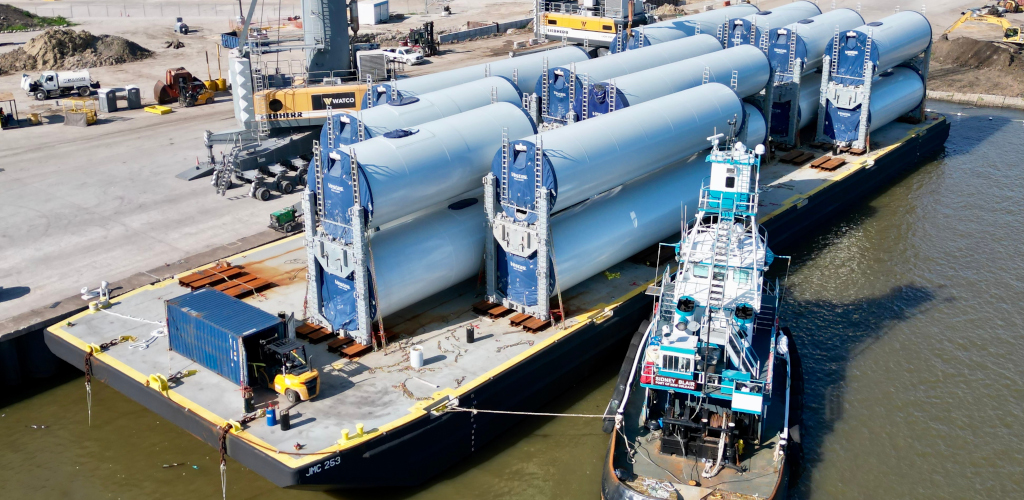
Top photo: Vestas wind tower sections being unloaded from a barge in the U.S. Credit: Hatch
_1.jpg?width=330&height=227&ext=.jpg)



.png?ext=.png)









.png?ext=.png)



_1.png?ext=.png)






_1.jpg?ext=.jpg)