
Unpacking the Supply Chain Challenge Facing the Americas Data Center Boom
Por Luke King
Miss a data center service-level agreement (SLA) and the consequences can reach US$1 billion — one operator was recently forced to surrender 10% of its stock when it failed to deliver on time. Those were the stakes laid out at the opening of the “Data Centers, Power Demand and the New Infrastructure Race” session at Breakbulk Americas.
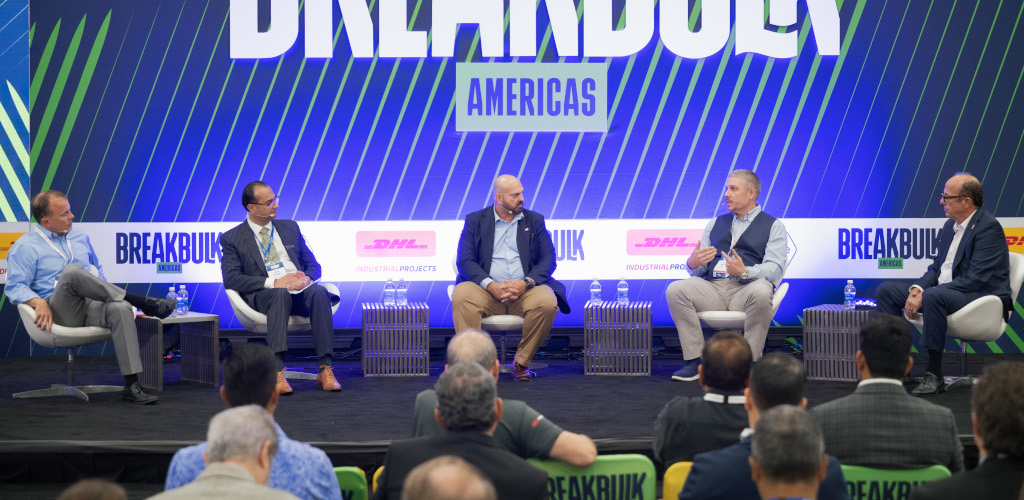
Moderated by Tim Sensenig, CEO of TMSFIRST.ai, the panel brought together Kevin Smith, senior director of modularization portfolio, cloud operations and innovation at Microsoft; Colin D’Abreo, VP director of global project logistics at Rhenus Logistics; Namir Khanbabi, general manager of Swire Projects; and Brandon Strange, international logistics director at Stellar Energy Americas.
Kevin Smith put the demand picture in context. “I firmly believe that data centers are becoming the next industrial technology needed for society to exist,” he said. “You go back through railroads, power grids, the internet, fiber — data centers are in that lineage.” With Microsoft running approximately 100 active projects in the U.S. alone, the scale of what that means for logistics is not theoretical.
Smith described a design philosophy built around standardization, ensuring that equipment destined for one site can be redirected to another when permitting or weather delays intervene. When SLA deadlines carry nine-figure penalty clauses, that flexibility is not optional. His wish list for logistics providers was equally direct: “Having companies that can understand those changing dynamics and navigate those changing environments quickly is the biggest asset we can see.”
Craft Labor Shortage
_2.jpg) The shortage of available craft labor on U.S. project sites is adding to the complexity. “Gone are the days where an electrician wants to leave Sunday night and be gone all week,” Smith said. The solution — fabricating and integrating equipment off-site and shipping it as modules — multiplies transportation steps, handoffs and logistical complexity. “You’re delivering from supplier to integrator, integrator to warehouse, warehouse to site,” he noted.
The shortage of available craft labor on U.S. project sites is adding to the complexity. “Gone are the days where an electrician wants to leave Sunday night and be gone all week,” Smith said. The solution — fabricating and integrating equipment off-site and shipping it as modules — multiplies transportation steps, handoffs and logistical complexity. “You’re delivering from supplier to integrator, integrator to warehouse, warehouse to site,” he noted.
“That volume and complexity is what creates the need for an integrated, end-to-end supply chain.” The challenge, he argued, is less about the dimensions of individual pieces of equipment. “It’s all about the volume.”
Brandon Strange, international logistics director at Stellar Energy Americas, described what that pressure looks like from the OEM side. His company, a modular cooling plant manufacturer acquired by Trane Technologies earlier this year, has grown from 120,000 square feet of operational space to 2.4 million square feet in under three years. Building and shipping fully assembled cooling plants means inbound raw materials and outbound finished modules hitting the logistics network simultaneously.
Permitting and weather delays in the past six months have created an unexpected wave of equipment in storage that nobody planned for, while connections with carriers and heavy haulers have taken on a new importance. “Relationships matter more than ever now,” he said. “The ability of people to have confidence in you, knowing what you’re doing — that’s what it’s all about.”
Colin D’Abreo, VP director of global project logistics at Rhenus Logistics, outlined the scale of data center demand building across Latin America, with Brazil emerging as the dominant market following the signing of the REDATA law, which offers operators tax incentives of up to 40% over five years, contingent on the use of clean energy.
With 87% of Brazil's power already coming from clean sources, that condition is straightforward to meet. D’Abreo emphasized that the core logistics challenge in the region is not moving the modules but sequencing them. “You can’t get module 17 before module 2,” he said. “Close coordination with everyone in the supply chain, including the manufacturer, is essential.”
Namir Khanbabi, general manager of Swire Projects, flagged two pressures converging on shipping capacity in the Americas. A developing Super El Niño is expected to restrict Panama Canal transits significantly, tightening already constrained multipurpose fleet availability at a moment when transformer and BESS (battery energy storage system) unit weights are increasing and ton miles across the sector are rising. His ask of shippers was direct: engage earlier. “Once you know the scale of the problem, you can commit capacity,” he said. “We don’t see enough of that.”
Strange had the closing word — and it was unambiguous. Power sector orders placed two years ago are only now beginning to deliver. The data center pipeline shows no sign of contracting. Stability, he acknowledged, is what everyone wants. “But that’s nowhere near close to where we’re at right now.”
Opportunities for project cargo amid the rapid buildout of AI infrastructure in Asia will be a key talking point at a panel session at Breakbulk Asia 2026 in November. “What does the AI infrastructure boom mean for project cargo?” will take place on the Breakbulk Live Stage on Thursday, Nov. 19 from 2:00pm-2:50pm.
Top photo (L-R): Brandon Strange, Colin D’Abreo, Namir Khanbabi, Kevin Smith, Tim Sensenig. Credit: Marco Wang Photography
Second photo: Colin D’Abreo addresses fellow panelists in Houston. Credit: Marco Wang Photography
_1.jpg?width=330&height=227&ext=.jpg)



.png?ext=.png)









.png?ext=.png)



_1.png?ext=.png)






_1.jpg?ext=.jpg)